

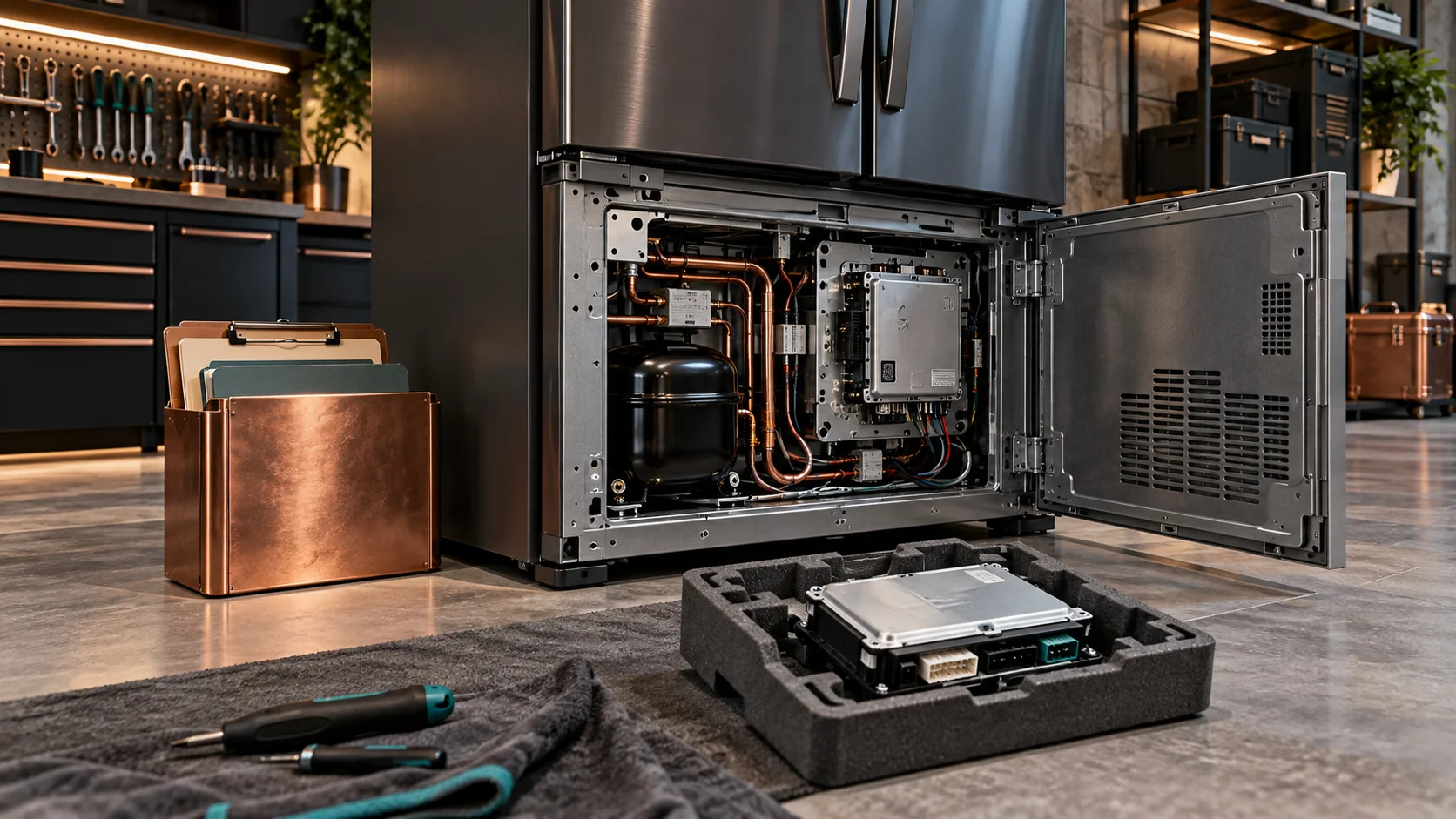
A refrigerator is repaired, the technician has left, and the job board says complete. The claim administrator still has no payable claim. A missing product identifier, an unexplained part substitution, or an unanswered return request can leave the work sitting between service completion and reimbursement.
Treat that interval as its own operating process. Link the repair record to a claim record with a named owner, the payer's current requirements, and separate submission, correction, decision, and payment states. The point is not to automate a coverage decision. It is to make the next unresolved action visible before completed work quietly becomes old receivables.
Separate the repair from the claim
Service completion answers whether the agreed field work was performed. Claim submission answers whether a particular request was transmitted to the payer. Acceptance, approval, and payment answer different questions again. One green badge cannot represent all of them accurately.
ServiceWorks describes its ServiceBench integration as a path for tracking and processing warranty claims after a job is finished. That product example illustrates the distinction; it does not establish the evidence requirements or reimbursement terms of every manufacturer or service plan.
Keep the payer's claim identifier beside the internal job identifier. If an export fails, retain the internal record and its error rather than marking the claim submitted. If an acknowledgment arrives, record what it acknowledges. Receipt of a file is not necessarily approval of its contents.
Make requirements specific to the program
A completeness check should reference a maintained program checklist, with its effective date and a person responsible for updates. Candidate fields include model and serial identity, service date, complaint and work description, authorization reference, installed parts, supporting evidence, and requested amounts. Whether each is required depends on the actual arrangement.
Do not copy one manufacturer's deadlines into every account. Staff should check submission windows, part-return instructions, allowed charges, and correction procedures against the current contract or portal. Missing requirements belong in an exception queue, not in guessed values inserted to satisfy a form.
Store only the customer information needed for the claim and restrict it to the relevant team. A claim processor needs the service evidence; that does not justify broad access to unrelated household records, payment credentials, or other customers' jobs.
- Finish the serviceLink the appliance, work performed, parts, and authorization evidence.
- Check the claimUse the current program requirements and retain missing items.
- Resolve responsesAssign returned or disputed claims and preserve submission history.
- Reconcile paymentMatch approval and remittance before closing the balance.
Follow one returned refrigerator claim
Consider a hypothetical appliance service company. Job R-418 records a completed control-module replacement. The company's claim board is the operational record for reimbursement, while the field-service system remains the source for the visit and parts used.
The claim coordinator prepares the submission from those records. A comparison finds that the installed module differs from the originally authorized reference. The coordinator asks the service manager to verify the substitution and its supporting authorization. The software preserves the discrepancy instead of silently rewriting the original job.
After submission, the payer returns the claim for a missing serial image. The board records the return reason, response date, responsible person, and the existing submission identifier. The coordinator obtains the evidence through the approved service channel, checks that it belongs to the correct appliance, and resubmits using the program's procedure.
Suppose the illustrative requested amount is $240, the approved amount is $210, and a remittance later shows $190 applied to that claim. The unresolved difference is $20 between approval and payment, not $50 between request and payment without explanation. Those numbers are an example of reconciliation, not a reimbursement forecast.
The finance reviewer determines whether deductions, offsets, or an incomplete remittance explain the difference. The system links the explanation and payment evidence before closing the balance. A claim that is disputed follows a separate review path rather than being repeatedly resubmitted as though nothing had happened.
Use an aging board that exposes the next action
The useful practical tool is a claim aging board with distinct queues:
- Ready to prepare: field work is complete, but a claim has not been assembled.
- Blocked before submission: a named requirement is missing or inconsistent.
- Submitted: the transmission and acknowledgment are recorded, with a follow-up date.
- Returned or disputed: the payer's reason, requested response, and responsible reviewer are visible.
- Approved but unpaid: the approved amount is awaiting remittance or reconciliation.
- Paid and reconciled: the payment is matched and any adjustment has a recorded disposition.
Track time in each state as well as total age. A claim submitted yesterday after three weeks awaiting evidence needs a different improvement from a complete claim waiting on a payer response. Keep original dates through corrections so resubmission cannot make an old claim look new.
Automate preparation without inventing entitlement
Ordinary rules can check required fields, detect duplicate claim identifiers, calculate age, and reconcile amounts. AI can summarize a return notice, extract candidate fields from an approved service document, or draft a precise evidence request. Staff verify product identity, coverage, authorization, and the final submission.
Never let a language model invent a serial number, infer that a replacement was covered, or promise payment. Low-confidence extraction should present the source and the uncertainty. Start with a sample of recent returned claims, identify the recurring blockers, and test one program checklist before connecting automated submission. Success means fewer avoidable incomplete claims and clearer outstanding balances, measured from the company's own records.
Sources & further reading
Primary references checked October 19, 2026. Examples are illustrative, not reported client outcomes.
- ServiceWorks describes its ServiceBench integrationPrimary background for the linked discussion. Use the actual application, current product documents, and qualified review for operating or acceptance decisions.