
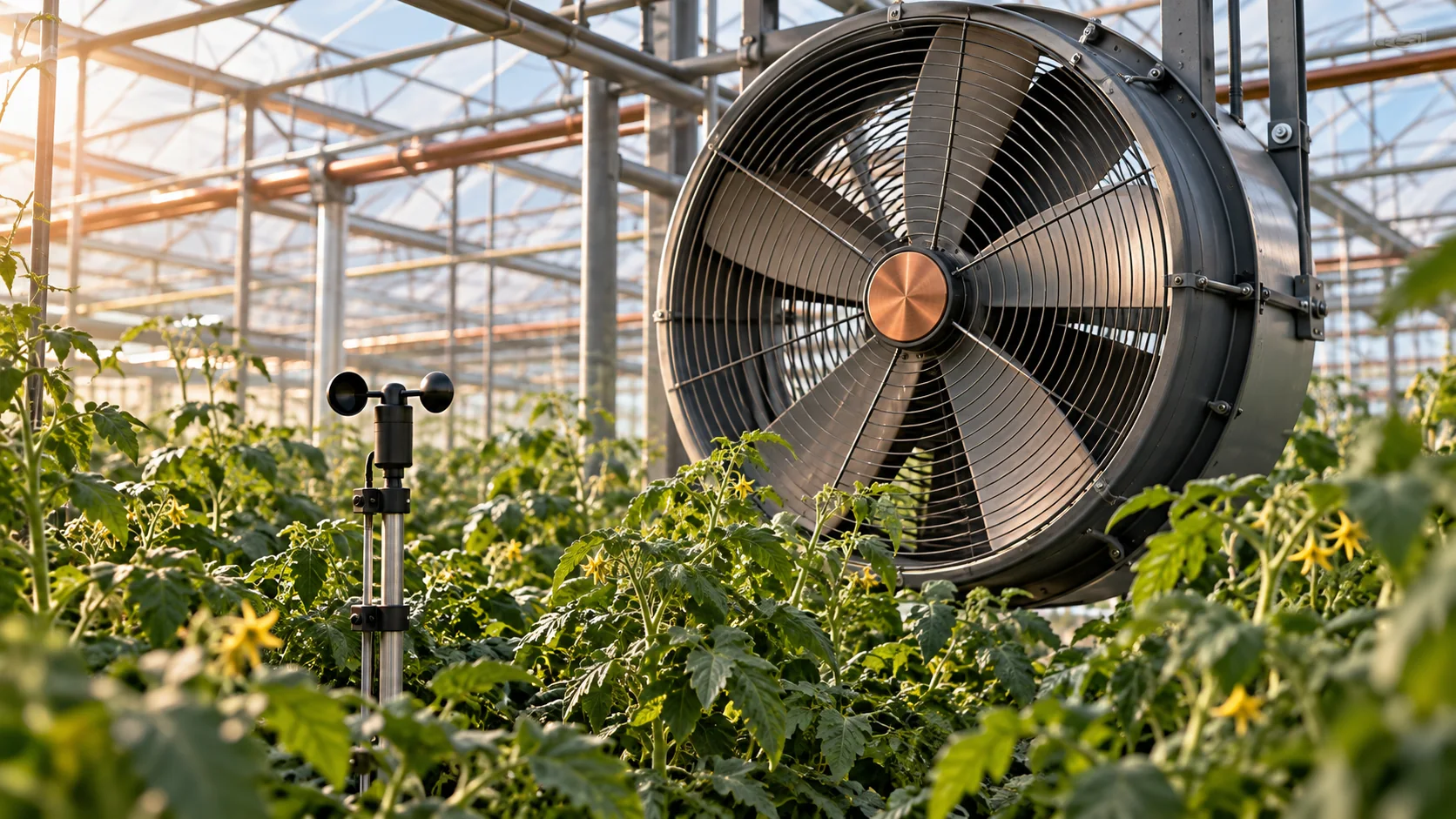
The fan indicator is green, but the crop has grown taller and denser since commissioning. Air movement measured in the aisle no longer tells the grower what is happening within the canopy. The equipment may be running exactly as commanded while the original airflow assumption no longer holds.
Survey the installed arrangement at the locations and heights relevant to the crop. Record the fan configuration, obstructions, crop stage, measurement method, and operating conditions. The result should inform a qualified engineering and grower review, not produce a universal fan speed or imply that motor status proves uniform crop conditions.
Start with the intended circulation pattern
Record what the fan arrangement is intended to accomplish and the installation guidance it follows. Identify the actual fans, positions, directions, control states, and any equipment or structural changes since commissioning. A drawing of the intended layout is useful only when compared with the installation that exists.
UMass Extension explains horizontal airflow in greenhouses. Its discussion supports reviewing circulation as a system. It does not establish that a particular site's layout achieves the same conditions or supply a universal target for every canopy and crop.
Choose survey points that can answer the grower's question, including difficult locations rather than just convenient aisle positions. Record height relative to the crop and the point's location. When the canopy changes, a fixed physical height may represent a different crop relationship, so preserve both descriptions.
Make measurements comparable
Select the measurement method with a competent technician and follow the instrument's instructions and site safety requirements. Instrument orientation, sampling period, and positioning can affect what is recorded. An instantaneous reading and a defined observation window are not automatically comparable.
Keep the relevant operating state with each result: which fans are running, screen and vent arrangement, doors, heating or other airflow sources, and unusual site activity. If those states change during a survey, mark the affected records rather than combining them into one apparently consistent map.
Do not use improvised access or remove guards to obtain a measurement. A location that cannot be checked safely remains unmeasured until a qualified team provides an appropriate method. A reporting requirement never authorizes work around moving equipment or other hazards.
- Map the arrangementRecord fans, crop structure, and intended circulation.
- Survey safelyMeasure defined crop-level points under documented conditions.
- Review the patternDistinguish comparable points, changed states, and gaps.
- Verify the responseRetest any authorized layout or configuration change.
Revisit a mature crop layout
Consider a hypothetical greenhouse where the crop now forms a dense barrier beside an aisle. The original commissioning record was made with young plants. The airflow survey register is the source of truth for the new observations and links to the original layout and equipment settings.
The technician repeats agreed points near the canopy and adds a clearly identified set behind the dense area. The grower records crop height and density observations. Several locations cannot be compared directly with the earlier survey because their crop relationship and operating state differ. The report shows that limitation instead of declaring the fans degraded.
Suppose the illustrative survey defines twelve points. Nine are measured under the specified configuration, two during a different vent state, and one is inaccessible. The report contains nine comparable points, two contextual observations, and one gap. It does not display twelve accepted locations because every point has a row in the spreadsheet.
The engineering and grower team reviews whether a controlled layout change or another survey is warranted. Any adjustment follows the approved equipment and crop process. After an authorized change, the technician retests the relevant points under documented conditions. A changed fan command alone is not closure; the follow-up must address the original crop-level question.
Build a canopy airflow survey map
Each point should link:
- Position: stable point ID, map, physical height, and relationship to the crop.
- Crop context: stage, approximate canopy structure, and relevant obstructions.
- Equipment state: fan identity, settings, direction, other airflow sources, and configuration reference.
- Method: instrument, applicable checks, orientation, observation duration, and operator.
- Result: measured observation with units, variability where available, and limitations.
- Review: suitability for the intended question, proposed action, authorization, and retest evidence.
Keep raw observations available alongside the map. A smooth color gradient between a few points can imply measurements that were never made. Label interpolation as an illustration if used, and make unmeasured areas visibly different from accepted ones.
Use AI to find missing context
Ordinary tools can compare point records, plot observations, and track configuration changes. AI can summarize the differences between surveys or flag that crop stage and vent state were omitted. It should not invent airflow between points or diagnose crop effects from the fan status.
Start with the zone where operators doubt the original assumption. The useful measure is whether the review produces a reproducible understanding of the installed arrangement and a verified next action. Revisit the record when the crop or physical layout changes materially. A fan that remains running is evidence about the fan; a crop-level survey is evidence about the part of the environment the grower actually needs to manage.
Sources & further reading
Primary references checked October 19, 2026. Examples are illustrative, not reported client outcomes.
- UMass Extension explains horizontal airflow in greenhousesPrimary background for the linked discussion. Use the actual application, current product documents, and qualified review for operating or acceptance decisions.