

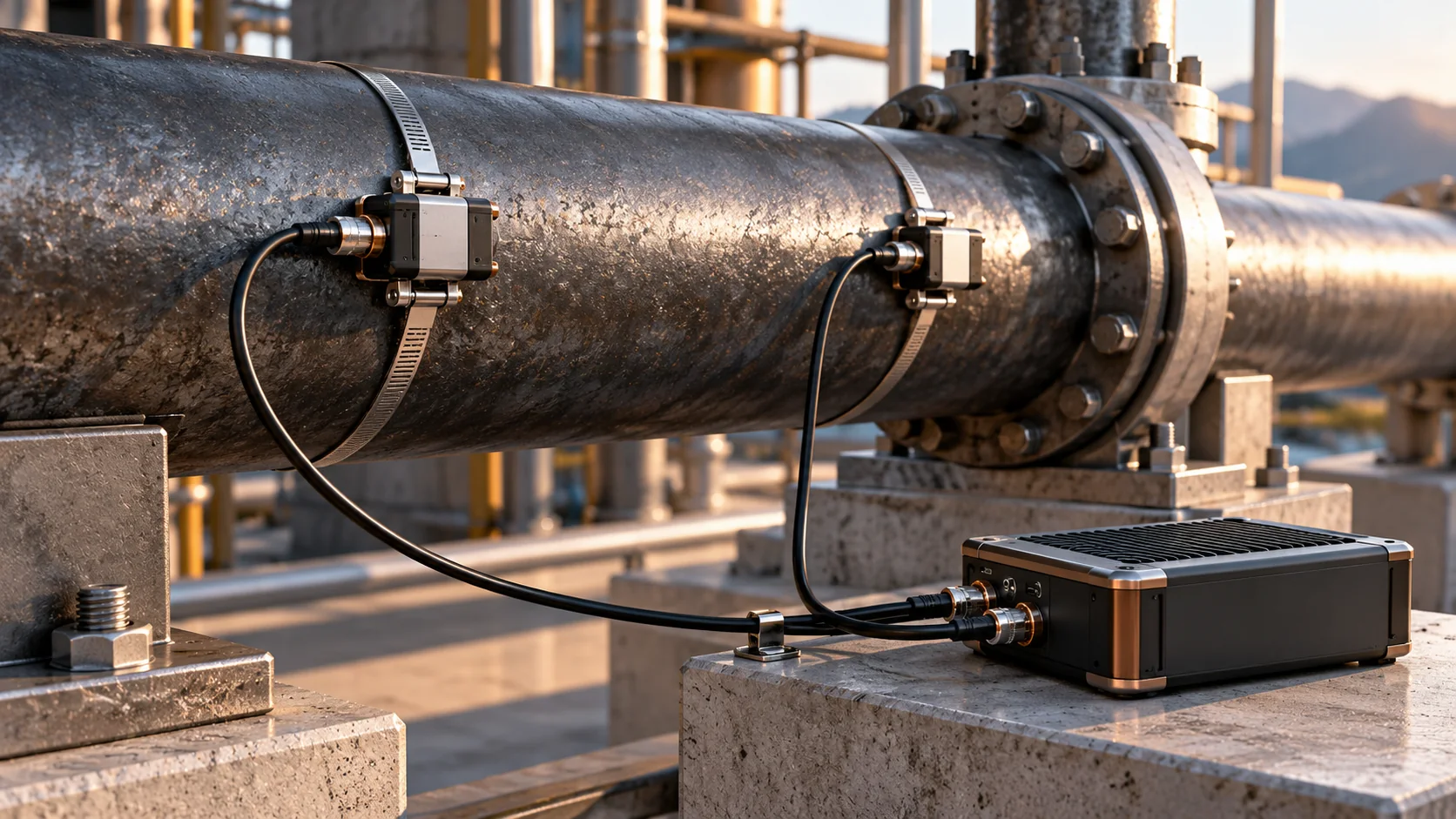
A facility wants to understand flow on an existing pipe without opening the line. Clamp-on ultrasonic instruments can make that a promising retrofit question. They do not make every pipe, fluid, location, and operating condition automatically measurable to the accuracy the business needs.
Run a feasibility review before treating a demonstration value as production evidence. Establish pipe and fluid facts, safe access, candidate requirements, operating range, and a suitable comparison plan. The outcome may be a temporary measurement campaign, a permanent installation proposal, or a decision that the available location cannot support the intended question.
Define the measurement purpose
Is the team comparing operating periods, estimating use, investigating a suspected imbalance, or supplying a control input? The required range, timing, uncertainty, and availability differ. A rough indication that supports investigation may be inadequate for a commercial transaction or consequential control.
Emerson describes clamp-on ultrasonic measurement as a nonintrusive approach with external transducers and transit-time measurement. That establishes a technology option, not a claim that a specific site can achieve a stated accuracy without application review.
Identify what the result will be compared with and how the business will use it. A measurement campaign should answer a defined question rather than collect a number simply because a device can display one. Keep the proposed use separate from any later permanent control or safety application.
Collect pipe and fluid facts
Candidate requirements can involve pipe material and dimensions, wall and lining information, fluid identity, temperature and operating conditions, flow profile, available mounting section, and physical access. Use the selected manufacturer's current documentation to determine the actual inputs and limitations.
Do not guess a wall thickness or fluid property because the setup screen requires a value. An uncertain input should have a source and a plan for verification. A stable display can still be based on the wrong configuration.
External mounting does not eliminate access hazards. Hot surfaces, elevated locations, moving equipment, hazardous-area requirements, and the condition of the pipe remain site questions for qualified people. A no-cut measurement proposal is not permission to work on any accessible-looking line.
- Define the decisionSet the measurement boundary and useful operating range.
- Verify application factsConfirm pipe, lining, fluid, access, and candidate requirements.
- Run a bounded trialKeep configuration, diagnostics, and operating windows.
- Validate the scopeCompare appropriate evidence and retain unresolved limits.
Test one existing water line
Consider a hypothetical facility planning a short campaign on a water line. The feasibility register is the source of truth for the reviewed application facts and candidate configuration. The technician follows an approved access and test plan, without opening the pipe or altering protective arrangements.
The first review finds that the pipe's lining and dimensions are not confirmed. The team obtains the required information through appropriate records or qualified assessment before entering the configuration. The test then records operating windows, device diagnostics, missing periods, and the basis for a comparison.
Suppose one illustrative window shows 12.4 cubic metres from the candidate and 12.0 from an independent comparison over the same interval. The difference is 0.4 cubic metres, about 3.3 percent of 12.0. That calculation does not establish instrument accuracy: the comparison's own uncertainty, location, timing, and operating conditions must be evaluated.
The engineer reviews whether both measurements represent the same flow boundary and whether unmeasured branches or storage could explain a difference. If they do not observe the same quantity, the comparison is unsuitable for the intended claim. The report preserves that finding instead of tuning the candidate until two unrelated totals match.
After a successful bounded trial, the decision states the accepted purpose and conditions. Unexamined low-flow, changing-fluid, or other relevant states remain outside the evidence. A longer campaign or different location may be needed before a permanent installation is justified.
Build a flow feasibility and validation sheet
Include:
- Question: intended decision, measurement boundary, useful range, timing, and acceptance requirement.
- Application facts: pipe and lining, dimensions, fluid, conditions, mounting section, and evidence sources.
- Access review: qualified owner, site constraints, applicable approvals, and permitted test arrangement.
- Candidate: exact device, transducers, configuration, documentation version, and unresolved requirements.
- Trial: operating windows, diagnostic quality, individual observations, unavailable intervals, and changes.
- Validation: comparison method and limits, findings, accepted scope, and further work.
Keep raw observations and configuration history. A later change to an assumed pipe input can alter the interpretation of earlier results. The reviewer needs to know which configuration produced which measurement, not just the latest settings on the device.
Let AI organize requirements rather than invent them
Ordinary software can retain application facts, align intervals, and calculate clearly defined differences. AI can summarize manufacturer questions or identify missing fields in the feasibility sheet. It should not guess unknown geometry, certify accuracy, or authorize an installation from a photograph.
Start with a bounded campaign at a location that qualified staff can assess safely. The business gains value when it knows whether the method answers its question and what limits remain. Sometimes the strongest result is avoiding a confident but poorly supported flow number that would otherwise drive energy, capacity, or maintenance decisions.
Sources & further reading
Primary references checked October 19, 2026. Examples are illustrative, not reported client outcomes.
- Emerson describes clamp-on ultrasonic measurementPrimary background for the linked discussion. Use the actual application, current product documents, and qualified review for operating or acceptance decisions.