

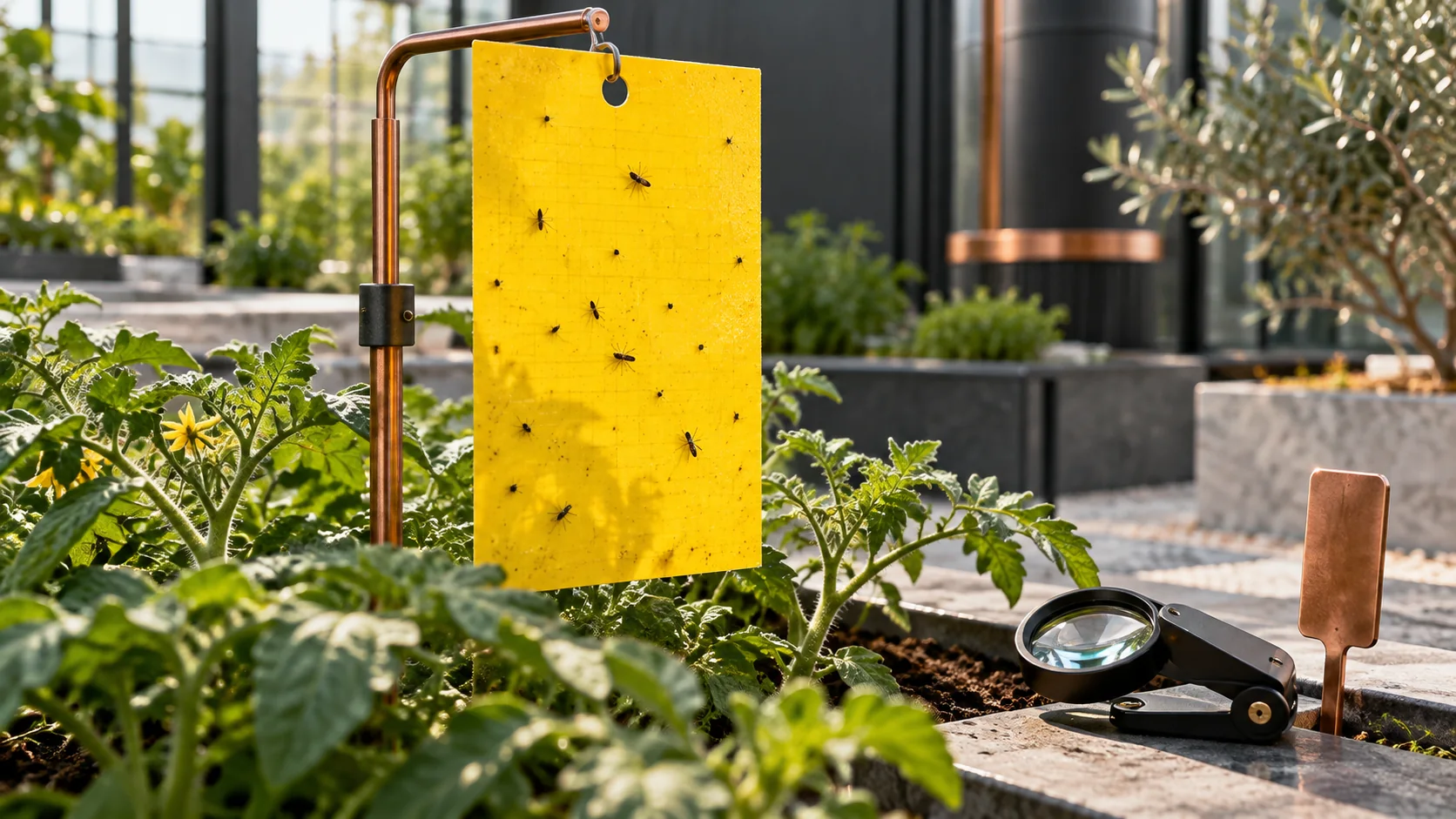
One scout records eight insects on a card. Another records fourteen a week later. The chart looks like an increase, but the second card was exposed longer and had moved to a different part of the house. The numbers are real observations that do not yet support the comparison people are making.
Turn scouting notes into a mapped follow-up plan. Keep the location, method, observation interval, identification confidence, and crop context with each count. Then give the qualified reviewer a specific question to resolve. Better records make inspection more useful; they do not turn an image classifier or a trap count into an automatic treatment decision.
Make the observation unit explicit
Define what was inspected: a particular card, a selected set of plants, a leaf position, or another established method. Keep a stable zone and device identifier. If a card moves, record the change so its history is not mistaken for observations from one unchanged location.
Penn State's scouting-plan guidance discusses sticky cards and plant inspection, including why cards alone do not capture every relevant pest observation. A digital system should retain these distinct methods rather than combine all findings into a single undifferentiated pest score.
Record the start and end of a card exposure where the comparison depends on that interval. A count collected after three days is not the same observation as a count collected after seven days. Normalizing a number by days may help organize information, but it does not remove every difference in trap condition, placement, crop, or pest behavior.
Preserve identification confidence
Allow suspected, confirmed by the qualified reviewer, and not identified. A photograph may be insufficient to identify a small specimen, and a damaged or crowded card may limit the count. Those limits belong with the result, not hidden in a note that disappears from the dashboard.
Keep beneficial organisms and pest observations distinguishable according to the approved scouting method. An automated count of all visible specks can be easy to produce and biologically unhelpful. If image assistance is used, validate it on representative cards and retain the original image for review.
The person responsible for crop protection determines whether additional identification, inspection, or another action is warranted. No count should automatically generate a pesticide instruction or a universal action threshold. The appropriate interpretation depends on the crop, organism, production system, and applicable professional guidance.
- Map the observationIdentify the zone, card or plants, and crop stage.
- Preserve the methodRecord exposure interval, placement, and confidence.
- Review comparabilitySeparate real patterns from changed sampling conditions.
- Follow the questionAssign identification or inspection and record its outcome.
Follow two apparently rising counts
In an illustrative high-tunnel operation, card S-12 records eight candidate observations after three days. A later card at the same named zone records fourteen after seven days. The scouting register is the source of truth for observations; the crop map retains the actual placement and any movement history.
The first draft chart ranks the second observation higher by raw count. A completeness check finds the different intervals and a placement change. The crop manager asks for a comparable plant inspection rather than treating the chart as proof that activity accelerated.
For arithmetic only, eight divided by three is approximately 2.67 observations per day, while fourteen divided by seven is two. That reversal illustrates why denominators matter. It is not a validated pest-population estimate, a treatment threshold, or proof the situation improved. Exposure, capture conditions, and identification still require review.
The scout revisits the defined zone using the agreed method, records the crop observations, and sends an uncertain specimen reference for qualified identification. The reviewer links the follow-up to both original records and sets the next inspection question. If the zone is inaccessible, the system records the missed observation and a rescheduling owner instead of entering zero.
Use a mapped scouting register
The practical register includes:
- Where: house, zone, crop, stage, card or sample identity, and placement changes.
- How: observation method, sampled plants or area, card condition, and exposure interval.
- What: count, category, image or specimen reference, confidence, and observer.
- Comparison limits: changed method, missing visit, incomplete interval, uncertain identification, or a damaged card.
- Follow-up: reviewer, question, next inspection, outcome, and the reference for any separately authorized action.
Keep a zero distinct from not checked. If the team cannot inspect a zone, an empty record must not flatten the trend into apparent absence. The grower should also be able to see whether changing sampling effort explains a change in the chart.
Make the next inspection more informative
Conventional software is well suited to stable identifiers, interval calculations, required fields, and reminders. AI can summarize notes and flag inconsistent zone names or missing context. A qualified person verifies identity matches and interprets crop significance.
Start with one house and one agreed method. Review whether successive observations can actually be compared and whether every open question receives a follow-up. Measure incomplete intervals, unresolved identifications, and missed inspections, rather than claiming a reduction in crop losses from a better chart. The strongest scouting system helps the grower ask a sharper question on the next crop walk and retain the evidence behind the answer.
Sources & further reading
Primary references checked October 19, 2026. Examples are illustrative, not reported client outcomes.
- Penn State's scouting-plan guidancePrimary background for the linked discussion. Use the actual application, current product documents, and qualified review for operating or acceptance decisions.