

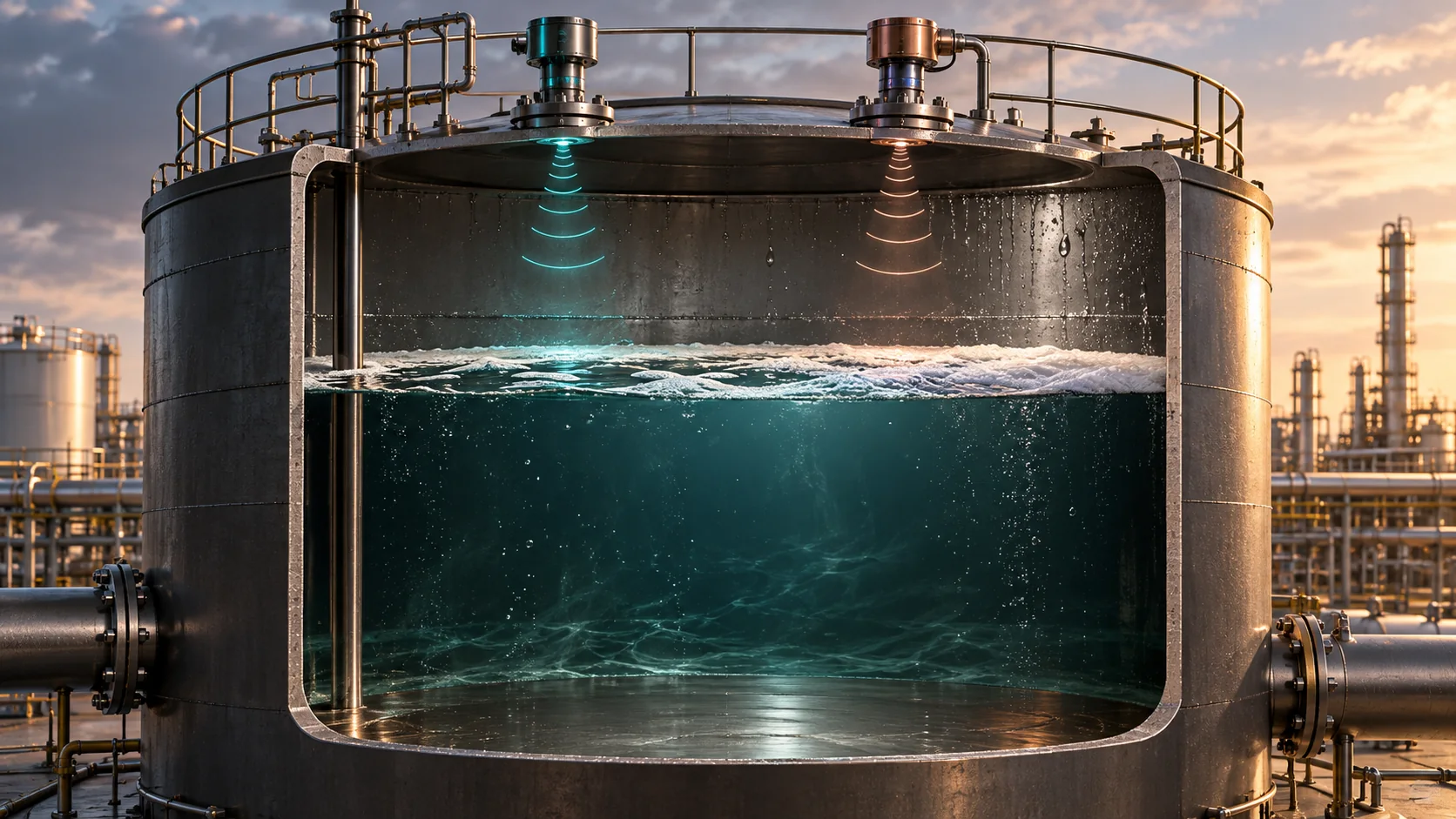
The level display behaves well during a quiet water test and becomes unreliable when the tank contains its normal material. Foam, condensation, turbulence, internal structures, or a different process condition can turn an apparently simple distance measurement into an application-selection problem.
Compare candidate methods against this tank, material, operating range, and installation. A radar or ultrasonic label is not a guarantee of suitability. The useful result is a verified measurement method with known limits and a clear response when the reading is unavailable, separate from any independent overfill or other safety protection.
Define the level the business needs
Is the operation trying to know liquid surface height, available inventory, or whether a limit has been reached? Those are related but different questions. A distance reading becomes volume only through an appropriate tank relationship, and foam height may not be the liquid level the process needs.
Record tank geometry, nozzles, internal obstructions, material properties, expected range, temperature and pressure conditions, and relevant surface behavior. Include normal cleaning and operating transitions. A trial at one convenient state should not be presented as qualification across every expected state.
Keep the intended use explicit. Inventory monitoring, process control, and a protective function can have different requirements. A monitoring project must not silently replace an independent safeguard because a new level trend looks convincing.
Compare mechanisms without universal winners
Ultrasonic instruments use sound propagation and its return from the target. Radar uses electromagnetic measurement. Their behavior depends on the specific instrument and application, not just the category name. Foam, condensation, mounting, and obstructions deserve application-specific review.
Endress+Hauser's continuous-level overview explains these principles and discusses limitations. It is a 2015 technical background reference, not a current specification for a candidate product. Use current manufacturer documentation and a qualified application review for the actual selection.
Avoid claims that radar ignores every foam condition or that ultrasonic always fails in a difficult tank. A defensible comparison names the material and operating state tested, the candidate configuration, the reference evidence, and what remains unresolved.
- Define the quantitySeparate level, volume, and protective-function questions.
- Describe the applicationRecord tank geometry, material, and operating states.
- Compare safelyRetain reference limits, diagnostics, and unavailable intervals.
- Accept an envelopeState the qualified decision and conditions not yet proven.
Follow a foaming tank comparison
Consider a hypothetical process tank where readings become intermittent during an operating stage that produces foam. The method-comparison register is the source of truth for the evaluation, linked to the tank information and approved instrument configurations. Qualified staff define a safe trial; there is no tank entry or improvised access.
The technical team obtains a suitable independent comparison method for the intended question. It records quiet, filling, and representative foaming windows where permitted. Each candidate's reported value, diagnostic state, missing intervals, and relevant tank conditions are retained together.
Suppose a trial has 60 scheduled comparison observations and one candidate provides 54 usable values under the declared rule. That is 90 percent usable observations for this illustrative test, not 90 percent accuracy or proof of suitability. The six unavailable values may occur precisely when the process most needs information, so their context matters as much as the overall ratio.
If the reference cannot distinguish the liquid surface during a particular state, the comparison remains unresolved there. The team does not declare the candidate wrong or right by selecting whichever reading looks smoother. A specialist reviews whether a revised installation, another technology, or a different measurement approach is justified.
The acceptance decision records the operating envelope and unavailable-reading behavior. Existing safety protections remain unchanged unless a separate, properly authorized engineering process addresses them. A successful inventory trial is not an approval to use the same device for overfill protection.
Build a level method comparison card
Include:
- Decision: quantity needed, intended use, response time, useful range, and acceptance criteria.
- Application: material, tank geometry, surface states, environment, and installation constraints.
- Candidate: exact device, configuration, current documentation, and manufacturer review.
- Reference: comparison method, uncertainty or limits, safe test arrangement, and relevant approvals.
- Evidence: paired observations, diagnostic states, unavailable intervals, and operating context.
- Conclusion: accepted envelope, unresolved limits, responsible engineer, and required further work.
Keep failures and invalid comparisons visible. A report that omits foaming periods because the readings were inconvenient can make the selected method look suitable while excluding the original problem. Label a state untested when the trial never encountered it.
Use AI to organize application facts
Conventional tools can align observations, preserve configurations, and distinguish missing values from valid readings. AI can compare documented specifications, draft vendor questions, and summarize the trial. It should not infer tank geometry, invent material properties, or select a safety arrangement from a generic description.
Begin with the process state that defeats the current measurement. Ask what evidence would establish a useful result there and who can assess it. The business gains clarity when it knows both what the instrument can support and when it should not be trusted. That is a stronger foundation for automation than choosing the technology with the most confident brochure.
Sources & further reading
Primary references checked October 19, 2026. Examples are illustrative, not reported client outcomes.
- Endress+Hauser's continuous-level overviewPrimary background for the linked discussion. Use the actual application, current product documents, and qualified review for operating or acceptance decisions.